
World Order Lab Participates in the Commemorative Conference on the 10th Anniversary of the 2016 South China Sea Arbitral Award
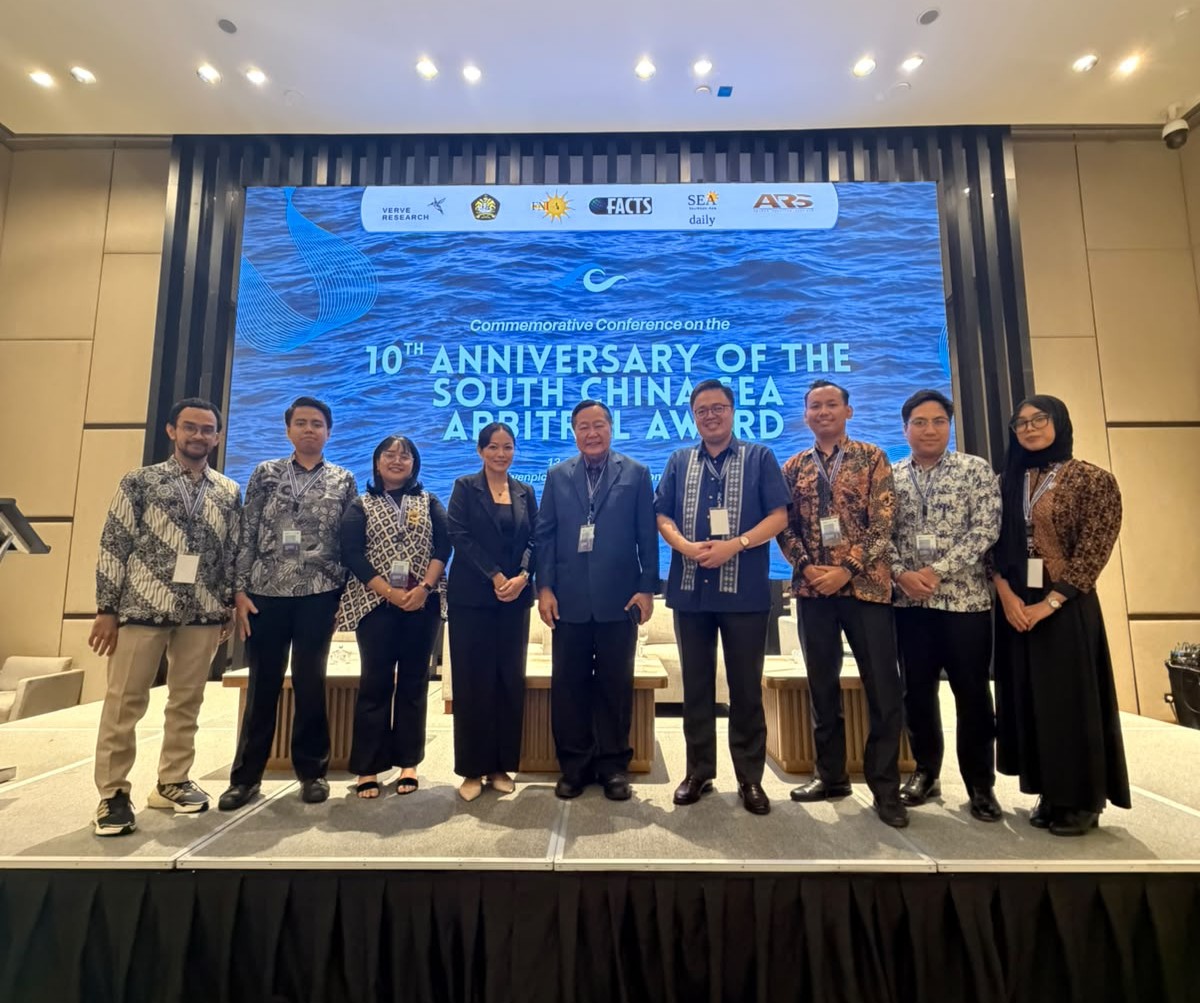

World Order Lab's Indonesia-based members participated in the Commemorative Conference on the 10th Anniversary of the 2016 South China Sea Arbitral Award, held in Jakarta on July 13 - 14, 2026.
Co-organized by Foundation for the National Interest, Amador Research Services, FACTS Asia, Universitas Pancasila, Verve Research, and Southeast Asia Daily, the conference brought together government officials, diplomats, legal experts, academics, and policy practitioners from across Southeast Asia to reflect on the enduring significance of the 2016 Arbitral Award and its implications for ASEAN, international maritime law, and the rules-based international order.
The two-day conference featured discussions on ASEAN's perspectives on the Award, the implementation of UNCLOS-consistent maritime governance, the South China Sea Code of Conduct, and the broader geopolitical, legal, environmental, and resource security challenges shaping regional cooperation. Notably, the event marked the first conference on the South China Sea Arbitral Award held outside the Philippines, which contributes to broader regional dialogue on advancing peace, stability, and cooperation in the South China Sea.
What are participating World Order Lab members' key takeaways and observations from the conference?
"The second panel on enforcing the Arbitral Award through law, technology, and cooperation stood out in particular for its compelling argument that while legal mechanisms remain essential, claimant states seeking to maximize the effectiveness of enforcing the award ought to prioritize building mutual trust and creating more opportunities for dialogue, recognizing that constructive engagement remains a pragmatic consideration in encouraging compliance." --- Muhammad Izzuddin Al Haq, Executive Director & Chair of Maritime Security Working Group
"The speakers didn't shy away from the tough conversations and offered refreshingly candid and constructive perspectives on the opportunities and shortcomings of the 2016 South China Sea Arbitral Award, which is interesting that their discussions went beyond legal doctrine to explore the intersection of ASEAN diplomacy, maritime governance, emerging technology, great-power competition, and whatnot. For the first conference on the South China Sea Arbitral Award held outside the Philippines — and in Indonesia, no less, ASEAN's natural leader — that was pretty significant. The only thing missing? Indonesian government officials. Unfortunate, but honestly, not exactly unexpected." --- Geo Arshali, Program Manager & Chair of G-2 Affairs Working Group
"The 10th SCS Arbitral Award Conference in Jakarta directly confronted the critical geopolitical tensions between Southeast Asian nations and the PRC over the South China Sea. Rather than dodging sensitive topics, the panelists delivered candid assessments and offered strategic pathways forward. They emphasized that countering these complex maritime claims requires a dual approach: aggressively strengthening intra-regional security cooperation while maintaining open, transparent diplomatic dialogue." --- Ibnurafi Andapura, Senior Analyst (Southeast Asia Desk)
"All this time, I only had a basic understanding of the South China Sea dispute, but this commemorative conference completely enlightened me on how deep and unresolved the layers of this conflict truly are. The speakers brought their diverse perspectives to the table, from practical, quick-win solutions, to long-term diplomatic processes. Ultimately, while this issue could easily be resolved if all parties chose peace and committed to existing international amendments and laws like UNCLOS, the real-world challenge lies in turning that legal consensus into actual compliance on the water." --- Nasya Lingga Carissa, Analyst (Transatlantic Desk) & Deputy Chair of Anti-Corruption Working Group
"Ten years after the 2016 South China Sea Arbitral Award, what struck me most was not the persistence of legal disagreements, but how the discussions revealed that the real challenge lies in translating legal principles into regional stability through diplomacy, ASEAN centrality, technological cooperation, and political will because ultimately, international law can provide the rules, but peace at sea still depends on states choosing cooperation over confrontation." --- Anna Tasya Nurfitriani, Analyst (Transatlantic Desk)
World Order Lab extends its sincere appreciation to the organizers and speakers for convening this timely conference, and look forward to supporting future initiatives that promote constructive ASEAN-led dialogue in advancing peace and stability in the region.
─────
Disclaimer: News & Announcement are written by the Communications Division of World Order Lab. All views, opinions, analyses, interpretations, and quotations contained in this article are those of the respective individuals quoted or referenced, unless otherwise stated. They do not necessarily represent or reflect the official views, positions, policies, or endorsements of World Order Lab, its whole leadership, members, affiliates, or partner organizations. World Order Lab publishes these quotations and reflections to document individual perspectives, with the aim of fostering constructive dialogue.
World Order Lab's News & Announcement is licensed under the Creative Commons Attribution-NonCommercial-NoDerivatives 4.0 International (CC BY-NC-ND 4.0) License, unless otherwise indicated. You are free to share this article for non-commercial purposes, provided that appropriate attribution is given to World Order Lab, a link to the original article and the license is included, and the material is not modified or used to create derivative works.
Image Courtesy of World Order Lab.
© 2026 World Order Lab. All Rights Reserved. | Terms and Conditions | Privacy Policy | Charter of Ethics & Integrity


World Order Lab is a youth-driven, nonpartisan, and non-profit think-tank dedicated to advancing rigorous analysis and producing high-impact insights on the world’s most pressing security and governance challenges, with a particular focus on Southeast Asia.