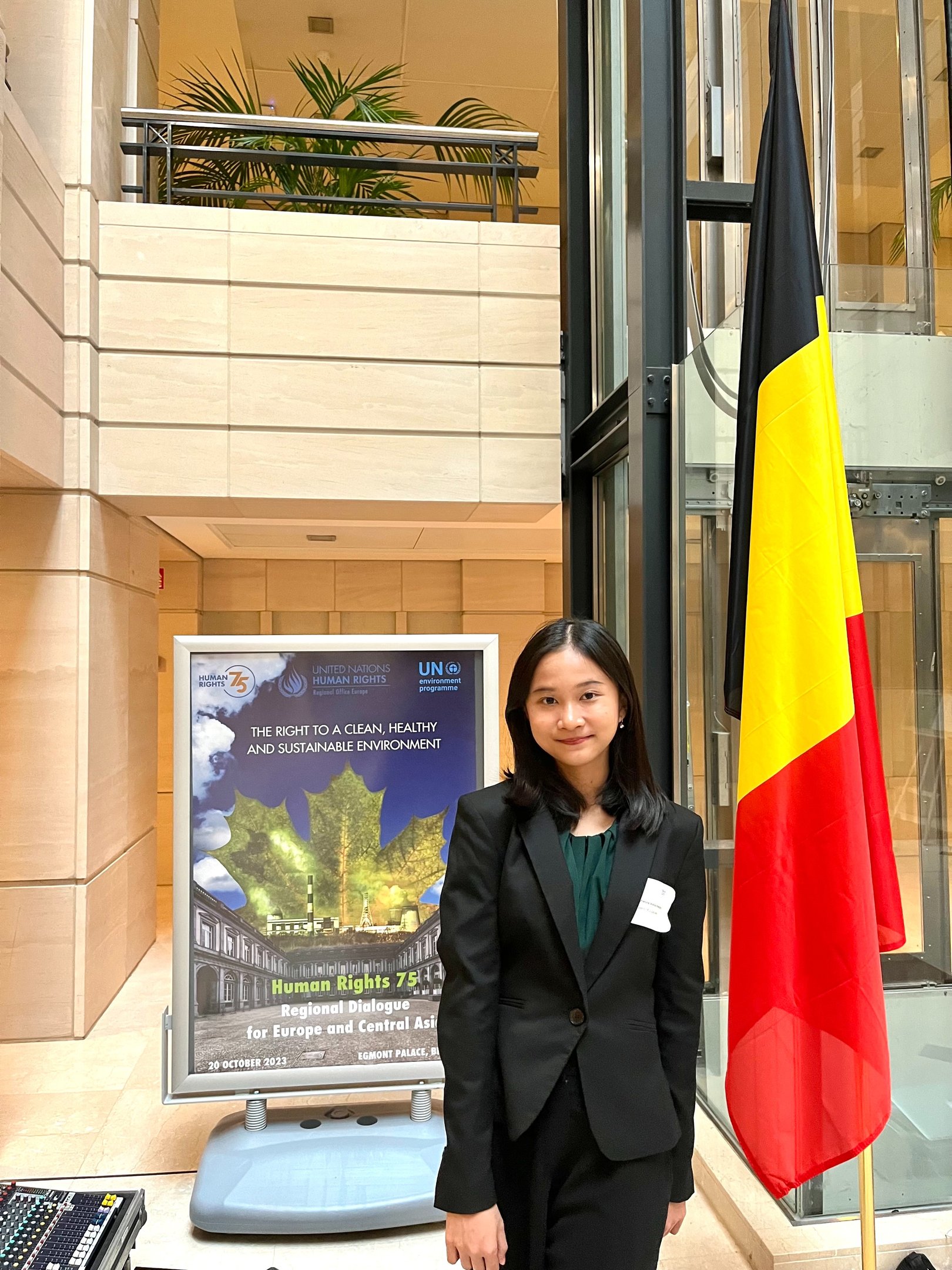
Katherine Viella Irwanto
[Former] Lead Analyst & Chair of Non-Proliferation Working Group (October 2025 - September 2026)
Katherine Viella Irwanto is a Former Lead Analyst & Chair of Non-Proliferation Working Group at World Order Lab, and a Media & Advocacy Contractor at Embassy of Canada in Indonesia. A natural policy analyst whose work focuses on foreign policy, international security, and Indo-Pacific affairs, she has experience in policy research, political risk analysis, strategic communications, and public diplomacy. Her interests include Indonesian and Chinese foreign policy, as well as East Asian regional security dynamics.
Katherine holds Bachelor's Degree in International Relations from the Faculty of Social and Political Sciences, Universitas Indonesia, where she graduated with distinction and ranked among the faculty's top eight graduates. During her undergraduate studies, she participated in the Indonesian International Student Mobility Awards (IISMA) program at Katholieke Universiteit Leuven in Belgium, where she earned distinction in courses on the European Union’s institutions and policies.
Professionally, Katherine began her career as a research assistant at Laboratorium Indonesia 45, where she contributed to a monograph titled The Role of the Indonesian Middle Class in Democracy. As a Research Fellow at The Horizon, she conducted research on Indonesia's defense capabilities in collaboration with the Indonesian Air Force and contributed to projects on intelligence and counter-terrorism in collaboration with the Indonesian National Counterterrorism Agency. She later joined Saudi Arabia-based Impetus Strategy as a Junior Analyst, conducting policy research and government liaison for public- and private-sector clients. Currently, she works for the Political and Public Affairs Section of the Embassy of Canada to Indonesia, supporting media analysis, policy research, strategic communications, and public diplomacy initiatives, while also serving as a part-time Research Assistant at the Faculty of Social and Political Sciences, Universitas Indonesia, where her research has focused on China-Global South cooperation and Indonesia's threat perception.
Her research focuses on foreign policy analysis, Indonesia's and China’s foreign affairs, Indo-Pacific security, ASEAN regionalism, and international political economy. She is particularly interested in how domestic political dynamics shape foreign policy decision-making and how middle powers navigate strategic competition in an evolving regional order.
Language: Indonesian (Native), English (C1), Korean (B1), French (A2).
Education:
Bachelor's Degree, International Relations
Faculty of Social and Political Sciences, Universitas Indonesia (2020- 2024)Non-Degree, Liberal Arts and Sciences Exchange Program
Faculty of Arts, KU Leuven (2023 - 2024)
—————————————
Research Interests
—————————————
Regional Focus
ASEAN
China-Global South Relations
China’s Foreign Policy
European Union
Foreign Policy Analysis
Group of Twenty Affairs
Indonesia’s Foreign and Security Policy
Indo-Pacific Geopolitics
International Security and Strategic Studies
Middle Class and Political Economy
Middle Power Diplomacy
Politics and Security in East Asia
Indonesia
Japan
South Korea
China
Southeast Asia
East Asia
Europe
Indo-Pacific
Asia-Pacific


Katherine Viella Irwanto
[Former] Lead Analyst;
[Former] Chair, Non-Proliferation
Working Group
Selected Articles & Publications
The Trump Corollary In Securing The Western Flank
Eurasia Review | January 30, 2026 | Co-Authored with Muhammad Farhan Yaumil RamadhanIndonesia Needs Offensive Cyber Defence Posture
Australian Outlook | November 6, 2025 | Co-Authored with Geo Dzakwan Arshali & Fransiscus Divo Marcellino PrasetiaRefleksi Delapan Dekade dan Proyeksi Indonesia 2045: Peran Kelas Menengah terhadap Demokrasi
Laboratorium Indonesia 2045 | Agustus 21, 2025 | Co-Authored with Baginda Muda Bangsa, Jessica Arreta, & Muhammad Zaidan
Event Participations
© 2026 World Order Lab. All Rights Reserved. | Terms and Conditions | Privacy Policy | Charter of Ethics & Integrity


World Order Lab is a youth-driven, nonpartisan, and non-profit think-tank dedicated to advancing rigorous analysis and producing high-impact insights on the world’s most pressing security and governance challenges, with a particular focus on Southeast Asia.